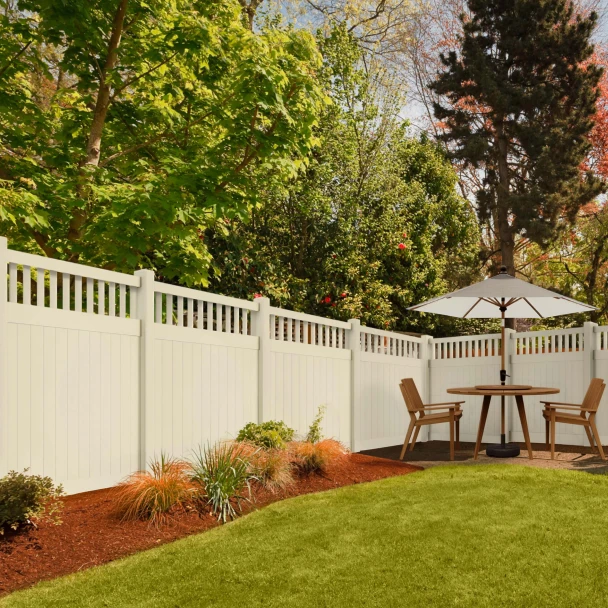
When comparing a vinyl vs. wood fence, wood typically costs less upfront, while vinyl can save money over time through lower maintenance and fewer repairs. However, the best choice depends on your budget, climate, and how long you plan to keep your fence.
Not all wood fencing is the same, either. Pressure-treated pine offers an affordable starting point, while cedar provides greater natural resistance to rot and insects at a higher price.
This guide compares vinyl, cedar, and pressure-treated pine fencing, including upfront costs, a 20-year cost comparison, maintenance requirements, lifespan, and practical considerations to help you choose the right material for your property.
Key Takeaways
- Choose vinyl (PVC) if: You want a low-maintenance fence that resists rot, moisture, and insects without regular staining or sealing.
- Choose wood if: You prefer a natural appearance, lower upfront cost, or greater flexibility to customize the fence’s height, style, and color.
- Upfront cost favors wood; long-term and total cost often favors vinyl: Wood fencing generally costs less initially, but ongoing maintenance and repairs can make it more expensive over time.
- Lifespan varies: Quality vinyl fencing typically lasts 20–30 years, compared to approximately 15–25 years for cedar and 10–15 years for pressure-treated pine.
- Cedar offers advantages over pine: Its natural resistance to rot and insects can make it a longer-lasting wood fencing option.
- Repairs differ: Individual wood boards are relatively easy to replace, while vinyl repairs may require replacing an entire panel or section.
- Climate matters: Vinyl is particularly appealing in humid, coastal, and termite-prone regions, while wood can perform well in drier climates with proper maintenance.
Vinyl vs. Wood Fence: At-a-Glance Comparison
Before comparing costs in detail, here’s how the three materials stack up.
| Feature | Vinyl (PVC) | Cedar | Pressure-Treated Pine |
| Typical material cost per linear foot | $20–$40 | $8–$20 | $6–$15 |
| Expected lifespan | 20–30 years | 15–25 years | 10–15 years |
| Maintenance | Annual cleaning | Stain or seal every 2–3 years | Stain or seal every 2–3 years |
| Rot and insect resistance | Excellent | Naturally resistant | Resistant when properly treated |
| Fading and weathering | May fade or chalk over time | Weathers to gray without treatment | Can warp, split, or discolor |
| Customization | Limited to available styles and colors | Highly customizable | Highly customizable |
| Repairs | Replace damaged components or sections; cost varies | Individual boards often inexpensive to replace | Individual boards often inexpensive to replace |
| Impact resistance | Can crack under strong impact, especially in cold weather | Can dent or split | Can dent, split, or splinter |
| DIY installation difficulty | Pre-engineered kits simplify assembly | Requires more measuring and cutting | Requires more measuring and cutting |
| Best-fit climate | Humid, coastal, and termite-prone. Also works well in dry climates. | Temperate or moderately wet | Dry or moderate climates |
Material costs are approximate planning ranges for residential fencing and exclude installation. Actual pricing varies by fence height, design, material grade, and location.
Cost: Is Vinyl Fencing Cheaper Than Wood?
The cost of PVC fence vs. wood depends on whether you’re comparing the initial purchase price or the total cost of ownership. Wood is generally more affordable upfront, but vinyl often becomes the more economical choice over a longer period.
Upfront Material Cost
Pressure-treated pine is typically the least expensive fencing material of the three, followed by cedar and vinyl.
For vinyl fencing, homeowners can expect material costs of approximately $20–$40 per linear foot, depending on the height, style, and design. A solid privacy fence generally costs more than a shorter picket or semi-private design.
Wood pricing varies by species and quality. Pressure-treated pine is usually the most affordable option, while cedar costs more because of its appearance and natural resistance to decay. Premium wood species, such as redwood, can cost as much as or more than vinyl.
If your primary concern is the lowest initial material cost, pressure-treated pine is often the best option.
Installation Cost
Installation costs also affect the wood fence vs. vinyl fence cost comparison.
Vinyl fence kits typically feature pre-engineered panels, posts, and rails that fit together during assembly. This reduces the need for extensive cutting and measuring, potentially saving time and labor costs.
Wood fencing often requires more on-site construction, particularly when installing individual pickets and rails. Each board must be measured, positioned, and secured, which can increase installation time.
However, both materials require proper post placement, digging, and concrete footings where specified. These steps can represent a significant portion of the overall installation cost.
Homeowners planning a DIY project can save on contractor labor with either option. For a more detailed breakdown, read our guide on how much a fence costs.
The 20-Year Total Cost of Ownership Model
While wood may be cheaper initially, the difference can change considerably over 20 years.
Consider a hypothetical 150-linear-foot, 6-foot-tall privacy fence. The following example includes professional installation, recurring maintenance, and estimated repairs or replacements.
Example assumptions:
- Initial installed cost: $6,000 for pressure-treated pine, $7,500 for cedar, and $9,000 for vinyl.
- Wood fencing is professionally stained or sealed every three years, costing $900 per treatment for both pine and cedar.
- Six staining treatments occur over the 20-year period, in years 3, 6, 9, 12, 15, and 18.
- Pine requires $600 in repairs and a $6,000 replacement at year 15.
- Cedar requires $350 in repairs but no complete replacement during the period.
- Vinyl requires $200 in minor repairs and annual DIY cleaning with negligible material costs.
- Prices are held constant for illustration and exclude inflation, financing, taxes, and disposal fees. The replacement fence is assumed to require no additional staining beyond the six treatments already included.
| 20-Year Expense | Vinyl (PVC) | Cedar | Pressure-Treated Pine |
| Initial installation | $9,000 | $7,500 | $6,000 |
| Staining or sealing | $0 | $5,400 | $5,400 |
| Estimated repairs | $200 | $350 | $600 |
| Full replacement | $0 | $0 | $6,000 |
| 20-year total | $9,200 | $13,250 | $18,000 |
Note: Costs are illustrative estimates based on a hypothetical 150-linear-foot privacy fence and are not guaranteed prices. Actual costs will vary depending on materials, location, installation, maintenance, and replacement needs.
In this example, vinyl’s higher upfront cost is offset by lower maintenance expenses over time. The exact point when vinyl becomes the more affordable option depends on installation costs, maintenance frequency, and whether either fence requires significant repairs or replacement.
Cedar fencing may also require replacement within the 20-year period, depending on climate, installation quality, and maintenance. For example, if the cedar fence in this comparison needed to be replaced at year 18, the total cost would increase substantially. However, a well-maintained cedar fence could last beyond 20 years without requiring a complete replacement.
The difference in long-term costs comes primarily from recurring maintenance and replacement expenses. Wood fences require ongoing treatment, while vinyl eliminates staining and sealing.
Homeowners who maintain wood fencing themselves, use less expensive materials, or avoid major repairs may see a different result. Similarly, vinyl fences with expensive installation or unexpected damage may take longer to recover their higher upfront cost.
To make the comparison more accurate for your property, substitute your actual fence length, local installation estimates, and anticipated maintenance expenses.
Where Wood Still Wins on Cost
Despite vinyl’s potential long-term savings, wood can be the more practical choice in certain situations.
For shorter fence runs, temporary fencing, or projects where only a small section needs replacing, wood’s lower initial cost may outweigh future maintenance expenses.
Wood can also be easier to install in phases because homeowners can purchase individual boards and materials as needed.
If you plan to move within a few years or simply need the lowest possible upfront investment, pressure-treated pine may make more financial sense.
For another budget-friendly comparison, explore our guide to chain link vs. wood fence cost.
Lifespan and Durability
One of the biggest differences between vinyl and wood fencing is how each material responds to weather, moisture, and everyday wear.
Vinyl fencing typically lasts 20–30 years with proper installation and maintenance. PVC doesn’t rot, absorb moisture like wood, or attract termites. However, prolonged UV exposure can cause fading or chalking, and strong impacts may crack panels, particularly in extremely cold temperatures.
Cedar fencing generally lasts 15–25 years when properly maintained. Cedar contains natural compounds that help resist rot and insects, making it more durable than many untreated wood species. However, it still requires regular care to prevent weathering, splitting, and moisture damage.
Pressure-treated pine fencing typically lasts 10–15 years, although actual performance varies considerably. Chemical treatment helps protect against rot and insects, but the wood can still warp, cup, crack, or splinter as it ages.
Regardless of material, proper installation is essential. Fence posts and footings are common points of failure, particularly in regions with freeze-thaw cycles or unstable soil. Posts must be installed at the appropriate depth, accounting for local frost-line requirements.
If you’re comparing post materials, our guide to steel vs. wood fence posts explains additional durability considerations.
Maintenance: What You’ll Actually Do Each Year
Maintenance is one of the most important differences between vinyl and wood fencing. Both benefit from routine inspections and cleaning, but wood requires significantly more ongoing care.
Wood Fence Maintenance
Wood fences generally need to be cleaned and stained or sealed every 2–3 years, depending on the climate, finish, and manufacturer’s recommendations.
Regular maintenance includes:
- Cleaning dirt, mildew, and debris from the surface
- Sanding rough areas before applying stain or sealant
- Inspecting boards and posts for rot, warping, or splitting
- Replacing damaged pickets and loose fasteners
- Keeping sprinklers from continuously soaking the fence
- Trimming vegetation and keeping mulch away from the bottom of the boards
Without proper maintenance, moisture can penetrate the wood and accelerate deterioration. Even naturally resistant materials like cedar benefit from protective treatments.
Vinyl Fence Maintenance
Vinyl fencing requires significantly less upkeep. For most homeowners, an annual cleaning with mild soap, water, and a soft brush is enough to remove accumulated dirt and debris.
Additional maintenance includes checking gate hinges and latches, inspecting posts for movement, and cleaning hard-water deposits caused by irrigation overspray.
Unlike wood, PVC fencing doesn’t require staining, sealing, or routine painting. Standard vinyl panels also shouldn’t be painted unless the manufacturer specifically allows it.
For more detailed upkeep recommendations, visit our fence maintenance guide.
The Honest Maintenance Comparison
For a typical backyard privacy fence, staining or sealing wood can become a multi-day DIY project or a recurring contractor expense every few years.
Vinyl maintenance, by comparison, may take only an afternoon of cleaning once a year.
However, wood has one advantage when it comes to appearance: it can be refinished. If a wood fence fades or changes color, homeowners can sand and restain it. Faded vinyl generally cannot be restored in the same way, making its original color and UV resistance important considerations.
Appearance, Style, and Customization
Both vinyl and wood fences are available in a variety of styles, but they offer different levels of customization.
Wood is popular for its natural grain and traditional appearance. It can be painted or stained in nearly any color, and homeowners can change the finish later. Wood boards can also be cut to custom heights and widths, making them suitable for unusual layouts, curved boundaries, and sloped yards.
Vinyl offers a cleaner, more uniform appearance with a factory-finished surface. Common colors include white, sand, and gray, while some products feature wood-grain textures that replicate natural wood.
Because vinyl fence panels are manufactured in standard sizes, customization can be more limited. On sloped properties, some systems support stepped installation, while others allow racking to follow the incline. Always confirm the installation options before purchasing.
If you live in a neighborhood with a homeowners association (HOA), check for fencing restrictions before selecting a material or color.
Both options can improve curb appeal and contribute to a property’s overall appeal to buyers. A well-maintained vinyl fence may be particularly attractive to buyers who prefer minimal upkeep, although material choice alone doesn’t guarantee higher resale value. Learn more about whether a fence increases property value.
Practical Trade-Offs Buyers Find Out About Later
Beyond cost and maintenance, there are several practical differences between vinyl and wood fencing worth considering before installation.
Hanging Decorations and Accessories: Wood fencing makes it relatively easy to attach lightweight decorations, hooks, and planters using appropriate fasteners. Many vinyl panels are hollow, so accessories may require special mounting hardware or attachment to reinforced posts. Avoid drilling into vinyl panels unless the manufacturer permits it.
Privacy and Noise: Solid tongue-and-groove vinyl privacy panels provide consistent coverage without the gaps that can develop when wood boards shrink. Both materials offer visual privacy, but neither should be considered a dedicated soundproofing solution.
Pets and Children: Vinyl doesn’t splinter and resists chewing and insect damage better than untreated wood. However, strong impacts from bicycles, sports equipment, or lawn tools can crack PVC panels. Wood may dent or splinter instead. For dogs that dig, both materials may require additional protection along the bottom of the fence.
Heat and Color: Dark-colored fencing can become hot in direct sunlight. This is worth considering near play areas, walkways, and plants, regardless of material.
Gates and Structural Attachments: Gate posts experience additional weight and movement, so proper reinforcement is essential. Oversized gates can place excessive stress on vinyl posts without suitable structural support.
Fire Resistance: Neither standard vinyl nor wood is ideal for direct exposure to wildfire conditions. Wood is combustible, while PVC can soften, melt, and decompose under intense heat. In high-fire-risk areas, noncombustible metal fencing may be more appropriate, subject to local fire-safety guidance.
Sustainability: Wood is a renewable material and can biodegrade when untreated, although chemical treatments and finishes affect disposal options. Vinyl is made from PVC, which isn’t biodegradable but may be recyclable through specialized programs. Its longer service life and reduced maintenance can also reduce the frequency of material replacement.
Which Should You Choose? Decide by Scenario
The best fencing material depends on your budget, maintenance preferences, and property requirements.
Choose Vinyl (PVC) If You Want:
- Minimal long-term maintenance without staining or sealing
- A durable fence with an expected lifespan of 20–30 years
- Resistance to moisture, rot, termites, and other insects
- A clean, uniform privacy fence design
- A DIY-friendly fencing kit with pre-engineered components
Choose Cedar If You Want:
- A natural wood appearance with resistance to rot and insects
- The flexibility to stain, paint, or change colors over time
- Easier customization for slopes, curves, or unusual dimensions
- A longer-lasting wood option than standard pressure-treated pine
- A balance between upfront cost and durability
Choose Pressure-Treated Pine If You Want:
- The lowest upfront fencing cost
- A practical option for a shorter ownership period
- Materials that are easy to cut and modify on-site
- Flexibility for phased DIY construction
- A traditional wood fence that can be painted or stained
Consider Composite (WPC) or Metal Instead If:
- You prefer a wood-like appearance without regular staining or sealing
- You want greater structural rigidity or impact resistance
- Your property requires additional security or specialized fencing
- You live in a high-fire-risk region where suitable metal fencing may be preferable
Wood-plastic composite (WPC) fencing offers another low-maintenance alternative for homeowners who like the appearance of wood. For a broader overview, explore our guide to fencing materials.
Climate Fit: Which Material Holds Up Where
Your local climate can significantly affect the durability and maintenance requirements of both vinyl and wood fencing.
| Region | Primary Concern | Material Considerations |
| Humid Southeast | Moisture, rot, termites | Vinyl generally offers lower maintenance and strong resistance to moisture and insects |
| Coastal Areas | Salt air, humidity | Vinyl resists salt-related corrosion and moisture damage |
| Arid Southwest | Intense sunlight, UV exposure | UV-resistant vinyl or properly maintained wood; fading and heat are important considerations |
| Upper Midwest & Northeast | Freeze-thaw cycles, extreme cold | Both can work with proper installation; vinyl may become more vulnerable to impact cracking in deep cold |
| Pacific Northwest | Frequent rain, damp conditions | Vinyl offers low-maintenance moisture resistance; cedar is another suitable option with proper care |
| High-Fire-Risk West | Wildfire exposure | Noncombustible metal fencing may be preferable near structures |
In southern and southeastern states, termite damage and high humidity can make wood fencing more demanding to maintain. Vinyl’s resistance to insects and moisture is particularly beneficial in these conditions.
Coastal homeowners may also prefer vinyl because it doesn’t corrode in salt air or absorb moisture like wood.
In colder climates, both materials require properly installed posts and footings to withstand freeze-thaw cycles. Vinyl can become less impact-resistant during extreme cold, while wood may experience splitting or movement as moisture freezes and thaws.
Explore ALEKO Vinyl and Composite Fencing
ALEKO offers a range of vinyl fencing designed to provide lasting privacy, durability, and low-maintenance performance.
Our PVC fence panels feature UV-resistant construction that helps prevent fading and weathering. Select designs include interlocking tongue-and-groove panels for privacy, anti-sag rails, and steel reinforcement inserts for added structural support.
Available in different heights, colors, and styles, ALEKO’s vinyl fence kits provide convenient options for DIY installation. Matching posts, caps, and compatible components help create a consistent, finished appearance.
For homeowners who prefer a wood-like appearance, our composite fencing offers an alternative that combines wood and plastic materials for improved resistance to moisture and reduced maintenance.
With free shipping on eligible products, ALEKO makes it easier to plan and price your next fencing project.
Price Your Fence, Then Compare
When comparing vinyl vs. wood fencing, consider both what you’ll spend today and what maintaining the fence may cost over the next 20 years.
Wood offers a lower initial investment and greater design flexibility, while vinyl provides long-lasting durability with minimal maintenance. Cedar can offer a middle ground for homeowners who prefer natural wood but want greater resistance to decay than standard pressure-treated pine.
Start by measuring your property and determining how much fencing you’ll need. Our guide on how much fence you need for your home can help you calculate your linear footage.
Then explore ALEKO’s fencing options, including vinyl fence panels and composite fencing, to compare styles, sizes, and costs for your project.