Choosing the best fence for dogs isn’t simply a matter of picking a material and enclosing your yard. The right fence depends on your dog’s size, activity level, and, perhaps most importantly, behavior.
Some dogs love to dig. Others are surprisingly good climbers or can jump over the fence when something catches their attention. Reactive dogs may bark or patrol the fence line whenever they see a neighbor, another dog, or wildlife. And small dogs can squeeze through gaps that might not seem like an issue for a larger pup.
That’s why choosing the right fence starts with understanding your dog. From chain link and steel to vinyl and other privacy fence options, different types of dog fences offer different advantages. This guide will help you compare fencing options for dogs and create a secure outdoor space that gives your dog room to enjoy the yard while giving you greater peace of mind.
Key Takeaways
- The best fence for dogs depends on your dog’s size and behavior, including whether they tend to jump, dig, climb, chew, or react to outside activity.
- Solid and semi-private fencing can reduce visibility and outside triggers for reactive dogs.
- Chain link and metal fencing provide durable containment and open sightlines, but additional precautions may be necessary for climbers and digging dogs.
- Fence height matters. Small dogs may be safely contained by a 3- to 4-foot fence, while large dogs and athletic escape artists may require a tall fence of 6 feet or more.
- Ground-level barriers, buried mesh, and other reinforcements can help prevent your dog from digging beneath the fence.
- Picket and mesh spacing should be small enough that your dog cannot squeeze through.
- Consider your dog’s behavior, fence material, fence height, layout, gates, and potential add-ons before installing your fence.
Start With Your Dog’s Escape Behavior (Not Just the Breed)
Breed can provide clues about a dog’s size and activity level, but two dogs of the same breed can behave very differently. One may be perfectly content inside your yard while another will investigate every possible escape route.
Before comparing backyard fences for dogs, consider how your dog behaves outside. Does your dog love to dig? Can they jump surprisingly high? Do they climb? Chew? Become fixated on people or animals beyond the fence?
These behaviors can help determine which type of fence is best for your dog and which additional safeguards your yard may need.
The Jumpers
Dogs that are able to jump standard fencing need enough fence height to make clearing the barrier difficult. For large dogs and athletic breeds, a 6-foot fence may be a better choice than a shorter picket fence.
The design matters, too. Horizontal or vertical slats can affect how easy a fence is to scale. A smooth, tall fence without horizontal footholds is generally more difficult to climb or launch from than a design that gives an athletic dog places to brace its paws.
Keep nearby landscaping in mind as well. Outdoor furniture, planters, wood piles, and other objects positioned near the fence can give a determined dog an unintended boost.
The Diggers
For digging dogs, fence height is only half the equation. A dog may be able to burrow beneath even a strong fence if there is enough space between the bottom of the fence and the ground.
A secure fence for a digger should minimize gaps at ground level. Depending on the yard and type of dog, additional defenses can include a bottom rail positioned close to grade, buried welded-wire mesh extending along the fence line, or a strip of concrete or pavers.
Pay special attention to corners and gates. If your dog has already discovered a favorite digging location, reinforcing that area can help prevent the behavior from turning into an escape route.
The Climbers
Some escape artists climb rather than jump. Chain-link fencing is durable and practical for many dog owners, but its diamond-shaped mesh can provide footholds for a dog that has learned to climb.
Widely spaced decorative fencing may create similar opportunities depending on its design. For a proven climber, a smooth-faced solid fence can be more difficult to climb.
A taller fence or an appropriate lean-in or topper may provide additional protection for persistent climbers. Whatever solution you choose, inspect the entire perimeter for objects, rails, or landscape features your dog may be able to use as a foothold.
The Chewers
A wood fence for dogs offers privacy and a traditional appearance, but persistent chewers can damage softer wood over time. Wood fences can also require maintenance to address moisture, rot, staining, and other weather-related wear.
For dogs that chew anything within reach, a durable material such as vinyl, composite, or metal may be a better fit. These materials can provide a long-lasting fence without giving your pup the same type of surface to gnaw.
The Reactive Barkers and Patrollers
For some dogs, the biggest issue isn’t escaping—it’s everything they can see outside the yard.
Dogs with a high prey drive or those that react strongly to pedestrians, neighboring dogs, vehicles, or wildlife may spend significant time barking and running along the fence line when visibility is open.
A solid fence or semi-private fence can reduce visual triggers. Vinyl and composite privacy-style fencing can be especially useful when you want to create a secure boundary while limiting sightlines. Privacy screens or mesh can also be added to some existing fencing systems to reduce visibility without completely replacing the fence.
Fence Materials for Dogs, Compared
There is no single best fence material for every dog or backyard. Budget, maintenance, visibility, durability, and your dog’s behavior all factor into choosing the right fence.
Chain Link
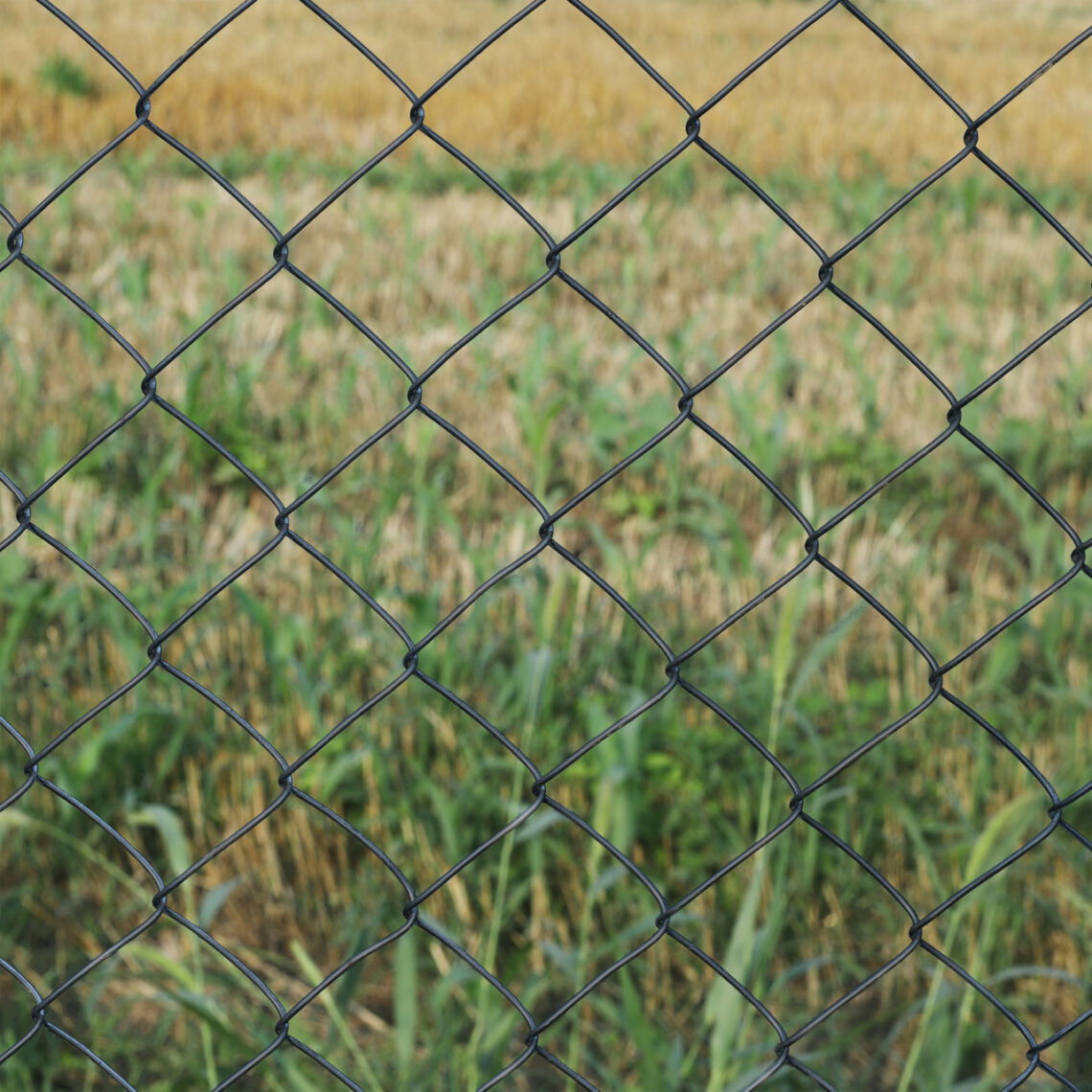
A chain link fence is one of the most versatile options for yard fencing for dogs. It creates a physical barrier without completely closing off your outdoor space, and the material is generally durable and low-maintenance.
ALEKO offers galvanized steel chain link fencing in multiple gauges, including options ranging from 12.5 gauge to heavy-duty 7 gauge. It’s important to remember that with chain link, a lower gauge number indicates a thicker wire. ALEKO’s 7-gauge options, for example, use security-grade galvanized steel and a tight 1.97-inch diamond mesh.
Homeowners can also choose between traditional silver galvanized fencing and black options. ALEKO’s black chain link is constructed from galvanized steel with a PVC coating that adds corrosion resistance while giving the fence a more finished appearance.
Chain link can be an especially practical dog fence for owners who want durability, visibility, and an economical way to enclose a larger area. ALEKO even identifies dog kennels among the potential applications for its chain link fence fabric.
However, consider your individual dog. The mesh can provide footholds for climbers, while reactive dogs may become overstimulated by the open sightlines. Privacy mesh or screens can help reduce visibility when needed. If you’re considering a DIY installation, check out our guide on how to install a chain link fence for step-by-step instructions.
Wood Privacy Fence
A wood privacy fence creates a solid visual barrier, making it a popular fence for dogs that bark, patrol, or become overstimulated by activity outside the yard.
Wood can also be customized in height, style, and finish, making it relatively easy to coordinate with your home and landscape.
The tradeoff is maintenance. Wood fences may require staining, sealing, painting, or repairs over time and can be vulnerable to rot, warping, and chewing. For a dog that regularly chews its surroundings, wood may require more upkeep than vinyl or metal alternatives.
Aluminum / Metal
Metal fencing is a strong, long-lasting option for dog owners who want durability without a solid privacy barrier. Vertical pickets can maintain visibility and complement a front yard or backyard landscape while creating a defined boundary.
Spacing is especially important for small dogs. If the gaps between vertical pickets are too wide, a small dog may be able to squeeze through. Look for appropriately spaced pickets or add a secondary barrier when necessary.
Steel fencing can also provide substantial strength. ALEKO’s Athens commercial-grade fence, for example, uses galvanized steel with a powder-coated, anti-rust finish. Its 6-foot-tall panels also feature built-in climb resistance, making this type of design worth considering for homeowners who want a strong fence with open sightlines.
Metal fencing does not block visibility, however, so it may not be the best choice for a highly reactive dog unless combined with another visual barrier.
Vinyl
Vinyl fences combine privacy potential with a smooth, low-maintenance surface. Unlike wood, vinyl does not need to be painted or stained and isn’t vulnerable to rot in the same way wood fencing is.
ALEKO’s Denver Series semi-private vinyl fencing, for example, combines a solid tongue-and-groove lower section with a picket top. Its PVC construction is designed to resist fading, rot, mildew, and moisture, while a steel rail insert reinforces the fence.
For dog owners, that combination can be particularly useful. The solid lower portion reduces gaps for dogs and limits some visibility at their level, while the upper pickets prevent the yard from feeling completely enclosed.
Composite fencing is another option for homeowners who like the appearance of wood but want less upkeep. ALEKO’s Charlotte Series semi-private fence uses wood-plastic composite boards with a wood-grain finish and is designed to resist rot, mildew, and moisture.
Both can be good fencing options for dogs when privacy, durability, and low maintenance are priorities.
Invisible / Electric Fences
An invisible dog fence works differently from every physical fence discussed above because there is no actual barrier surrounding the yard.
That distinction is important. An invisible system does not physically prevent another dog, wildlife, or people from entering your property. It also does not create the same physical containment as chain link, vinyl, wood, or metal fencing.
Dogs may also cross the boundary despite the deterrent, particularly when highly stimulated. For homeowners prioritizing physical containment, an invisible system should not be treated as equivalent to a physical dog fence.
How Tall Should a Dog Fence Be?
A fence is only effective if your dog cannot easily get over it. The appropriate fence height depends on the size of the dog as well as jumping ability, activity level, and previous escape behavior.
Height by Dog Size
As a general starting point:
- Small dogs may do well with fencing around 3 to 4 feet high.
- Medium or active dogs may require approximately 5 feet.
- Large dogs, highly athletic dogs, and proven jumpers may need a fence 6 feet high or taller.
These are guidelines rather than guarantees. A small but athletic dog may be able to jump a surprisingly tall fence, while a calm large dog may never attempt to jump at all.
Observe what your dog is capable of before deciding what fence height is sufficient. If you already know your dog is able to jump a certain height, build in additional clearance rather than choosing a fence at that exact height.
When to Add a Topper or Lean-In
A topper or inward-angled extension can provide another obstacle for dogs that have learned to jump or climb standard fencing.
These additions are most relevant for proven escape artists rather than every backyard dog. Before adding one, make sure the solution is appropriate for your fence design and complies with local building, HOA, and property requirements.
Stopping Diggers: Ground-Level Defenses
For a dog that loves to dig, the strongest fence in the world will not solve the problem if there is an easy route underneath it.
Start by keeping the bottom of the fence as close to ground level as the installation allows. Walk the fence line regularly and look for gaps created by erosion, landscaping, or repeated digging.
For persistent digging dogs, consider burying welded wire along the fence line. An L-shaped apron extending inward from the fence can make it more difficult for your dog to burrow beneath the boundary.
Concrete, pavers, or a gravel strip can also create a harder-to-dig zone along problem areas. Whatever approach you use, check the fence regularly. Catching a new digging spot early is easier than repairing a nearly completed escape tunnel.
Picket and Mesh Spacing for Small Dogs
Small dogs present a different containment challenge: they may not need to go over or under the fence if they can simply go through it.
Pay close attention to openings between pickets, beneath gates, and around posts. As a general guideline, keeping gaps below approximately 3 to 4 inches can reduce the chance that many small dogs will squeeze through, but the right spacing ultimately depends on your dog’s body and head size.
For chain link, mesh size is another consideration. ALEKO’s 7-gauge black chain link fence fabric, for example, uses approximately 1.97-inch diamond mesh, while its 12.5-gauge galvanized chain link products use approximately 2-inch mesh.
For decorative metal fencing, look closely at vertical picket spacing. If your preferred fence offers gaps that are too large for your pup, a compatible secondary barrier may be necessary.
Layout and Gate Considerations
The type of fence is only one part of creating a safe dog fence. How you arrange the fence and access the space matters just as much.
Choosing a Yard Layout
A full-perimeter fence gives your dog the greatest amount of outdoor space, but it isn’t the only option.
Depending on your property, you might enclose only the backyard, create a dedicated dog run, or design a landscape loop that separates your dog from pools, gardens, play areas, or other spaces.
Consider how your dog actually uses the yard. A high-energy dog may benefit from enough space to run and play, while a smaller or less active dog may be comfortable in a more compact enclosed area with appropriate enrichment.
Your landscape matters as well. Slopes and uneven terrain can create gaps beneath standard fence panels if they aren’t accounted for during installation. Some fencing is designed specifically to accommodate slopes. ALEKO’s Tokyo Style commercial-grade steel fence, for example, is designed for installation on flat or sloped terrain up to 30 degrees.
Self-Closing Gates and Secure Latches
The gate can quickly become the weakest part of an otherwise secure fence.
Choose a latch your dog cannot easily bump, paw, or manipulate open. A self-closing gate can add another layer of protection by reducing the chance that someone accidentally leaves the entrance open.
Check the space beneath and beside the gate as well. These areas can develop larger gaps than the rest of the fence, particularly on uneven ground.
For especially determined dogs, a lockable or secondary latch positioned out of reach can provide additional security.
Quick Cost and Best-Use Comparison
Actual fence costs depend on material, yard size, fence height, labor, site conditions, and whether you choose professional or DIY installation. However, each material has some general advantages and tradeoffs. For a closer look at the factors that affect pricing, see our guide on “How Much Does a Fence Cost.”
| Fence Type | Relative Cost | Best Suited For | Considerations |
| Chain link | Lower | Budget-conscious dog owners, larger yards, dogs that don’t climb | Open visibility; diggers and climbers may need additional safeguards |
| Wood | Moderate | Reactive dogs and yards where privacy is important | Requires maintenance; may rot, warp, or be damaged by chewers |
| Vinyl | Higher | Privacy, chewers, and homeowners seeking low maintenance | Higher upfront cost than some fencing options |
| Metal/steel | Moderate to higher | Durability, security, visibility, and curb appeal | Picket spacing matters for small dogs; open sightlines may trigger reactive dogs |
| Composite | Higher | Privacy, wood-like appearance, and lower maintenance | Higher upfront cost but avoids some maintenance associated with traditional wood |
Rather than choosing solely based on what is least expensive to install, consider long-term fence maintenance and whether the fence actually addresses your dog’s behavior. Installing the wrong fence and having to modify or replace it later can eliminate the savings of choosing the cheapest option initially.
Pre-Purchase Checklist for Dog Owners
Before purchasing fencing for dogs, walk through these questions:
- Does my dog jump, climb, dig, chew, or patrol the fence line?
- What fence height will safely contain my dog?
- Are the picket or mesh gaps small enough for my dog?
- Does my dog need a solid fence to reduce visibility?
- Do I need protection below the fence for digging?
- Is the fence material durable enough for my dog and climate?
- Where will the gate be located, and how will it latch?
- Are there objects near the fence that could help my dog jump or climb?
- Does the fence work with the slope and landscape of my yard?
- Do HOA rules, local codes, or permits limit fence height, material, or placement?
- Am I prepared for the maintenance this type of fence requires?
Answering these questions before buying can help you create a secure yard without costly changes later.
Build a Safe Yard for Your Dog With ALEKO
The best fence for dogs is one that fits both your property and your pup. Instead of choosing fencing based on appearance or breed alone, consider how your dog behaves, how much space they need, and where they are most likely to find a way out.
ALEKO offers several fencing options that can be used to create a secure outdoor space, including galvanized chain link fencing, PVC and composite fencing, and durable steel fence systems. Chain link options range from 12.5 gauge to heavy-duty 7 gauge, with traditional silver and black PVC-coated options available for different projects and preferences.
For yards where visibility is a concern, semi-private vinyl or composite fencing can create more separation from outside distractions. For homeowners prioritizing strength and open sightlines, galvanized steel fencing offers another durable option. ALEKO’s current vinyl, composite, and select steel fence systems are available in 6-foot heights, providing options for homeowners who need a taller backyard boundary.
Whether you’re keeping a small pup safely inside your yard or building a stronger boundary for an athletic escape artist, choosing the right material, height, spacing, and ground-level protection will help create a yard your dog can enjoy safely.