
If you’re weighing a sauna against the hit to your electricity bill, here’s the short version: a traditional home sauna session typically uses about 4 to 8 kWh, costing roughly $0.70 to $1.50 at the current U.S. average rate. Go with infrared instead, and that drops to around 1 to 2 kWh a session.
You’ve probably come across wildly different numbers for this online, and there’s a simple reason why. Most articles just multiply the heater’s rated wattage by however long you run it, as if the heater stayed at full blast the entire time. It doesn’t work that way in practice, and this guide walks you through what you’ll actually pay, with a cost table by heater size, and an infrared versus traditional comparison.
Main Takeaways
- A typical session costs $0.70 to $1.50, using roughly 4 to 8 kWh at current U.S. rates.
- Three to four sessions a week usually lands between about $10 and $25 a month, depending on heater size and local electricity rates.
- Rated power isn’t what you pay, since the heater runs at full power only while warming up, then cycles at roughly 30 to 50% of rated output, meaning multiplying rated kW by session length overstates cost by 40 to 60%.
- Warm-up is the expensive part, typically accounting for 50 to 65% of a session’s total energy use.
- Infrared uses less power but not always proportionally less, since cabins typically run 1.5 to 2.5 kW with little or no preheat, though sessions often run longer.
- Voltage doesn’t change your bill: a 240V sauna doesn’t cost more to run than a 120V one at the same wattage, since you pay for kilowatt-hours, not volts.
- Insulation, placement, and habits matter more than heater brand, since door seals, glass area, ambient temperature, and preheat time can swing consumption 30% or more.
How Much Electricity Does a Sauna Use?
Those headline numbers assume a well-insulated family sauna with a 6 to 8 kW heater at the current U.S. average residential rate of roughly $0.18 per kWh. Rates vary a lot by state, from around $0.13 per kWh in the cheapest states to well over $0.40 in the most expensive1, so your actual cost could land outside that range.
For your own number, check the cost-per-kWh line on your utility bill rather than relying on a national average. Your local rate matters more than any figure in this guide.
What You’ll Actually Pay
A sauna heater runs at full power only while it’s warming up the room, usually 30 to 45 minutes for a traditional sauna. Once the cabin reaches its set temperature, the thermostat cycles the elements on and off to hold it there, averaging roughly 30 to 50% of rated output for the rest of the session.2
A 6 kW heater running a 45-minute warm-up plus a 45-minute session, for example, works out to about 6.3 kWh, not the 9 kWh you’d get from simply multiplying 6 kW by 1.5 hours.
The table below shows what that looks like across common heater sizes, assuming a 45-minute warm-up, a 45-minute session, and a well-insulated cabin:
| Heater Size | kWh per Session | Cost at $0.13/kWh | Cost at $0.18/kWh (national avg.) | Cost at $0.32/kWh (high-rate states) |
| 3 kW | 3.2 | $0.41 | $0.57 | $1.01 |
| 4.5 kW | 4.7 | $0.61 | $0.85 | $1.50 |
| 6 kW | 6.3 | $0.82 | $1.13 | $2.02 |
| 8 kW | 8.4 | $1.09 | $1.51 | $2.69 |
| 9 kW | 9.5 | $1.23 | $1.70 | $3.02 |
*These figures are our calculations based on that methodology, so treat them as a close estimate rather than a measured figure for your specific setup
For most households, sauna electricity is a $10 to $30 a month line item, not a $100 one. Running a 6 kW heater three times a week, for example, works out to roughly $15 a month at the national average rate, which you can scale up or down from the per-session numbers above based on how often you actually use yours.
Infrared vs. Traditional Sauna Electricity Use
Power Draw
Traditional electric heaters for a family-size room commonly run 4.5 to 9 kW, since they heat both the air and the rocks to much higher temperatures. Infrared cabins are commonly 1.5 to 2.5 kW, since the panels heat your body directly rather than heating the whole air volume.
Preheat Time
A traditional sauna typically needs 30 to 45 minutes to preheat, and that’s where most of its energy goes. An infrared cabin usually needs only 10 to 20 minutes, and some models are usable almost immediately.
The Per-Session Comparison
A typical 6 kW traditional session costs around $1.13 at the national average rate. A typical infrared session, even though it often runs longer at 30 to 45 minutes of actual use, costs closer to $0.30, since the lower wattage outweighs the longer runtime.
The gap is real, but it’s smaller than the raw wattage difference suggests. Naively multiplying rated watts by hours would put traditional sessions at roughly five times the cost of infrared.
Once you factor in that traditional heaters cycle down after warm-up while infrared panels draw closer to continuously, the real gap is closer to three or four times, not five. Either way, infrared costs less to run, but per-session cost is only one input when weighing an infrared vs. traditional sauna, since heat type, ramp-up time, and the experience itself usually matter more to most buyers.
What Drives Your Sauna’s Running Cost, and How to Lower It
A few factors matter more than most buyers expect, and each one comes with a fix.
Heater Size
An undersized heater runs longer at full power trying to reach temperature, and an oversized one short-cycles constantly. Both cost more than a heater correctly matched to the cabin’s volume. Right-size the sauna and heater to the number of people who’ll actually use it, not the number you might host once a year.
Insulation and Door Seals
A foil vapor barrier and solid wall insulation keep heat where it belongs, and the glass door or window is usually the single largest heat-loss path in the cabin. Check door gaskets once a year and replace them if you see a visible light gap. It’s a five-minute job that keeps paying for itself.
Placement and Season
An outdoor sauna in January faces a much larger temperature gap to overcome than the same unit in July, which lengthens warm-up and raises the maintenance-phase duty cycle. Keep outdoor units sheltered from wind where possible, since wind exposure extends warm-up on its own. An indoor sauna partly returns its heat to the house, which offsets some of that cost during the warm season.
Cabin Shape and Size
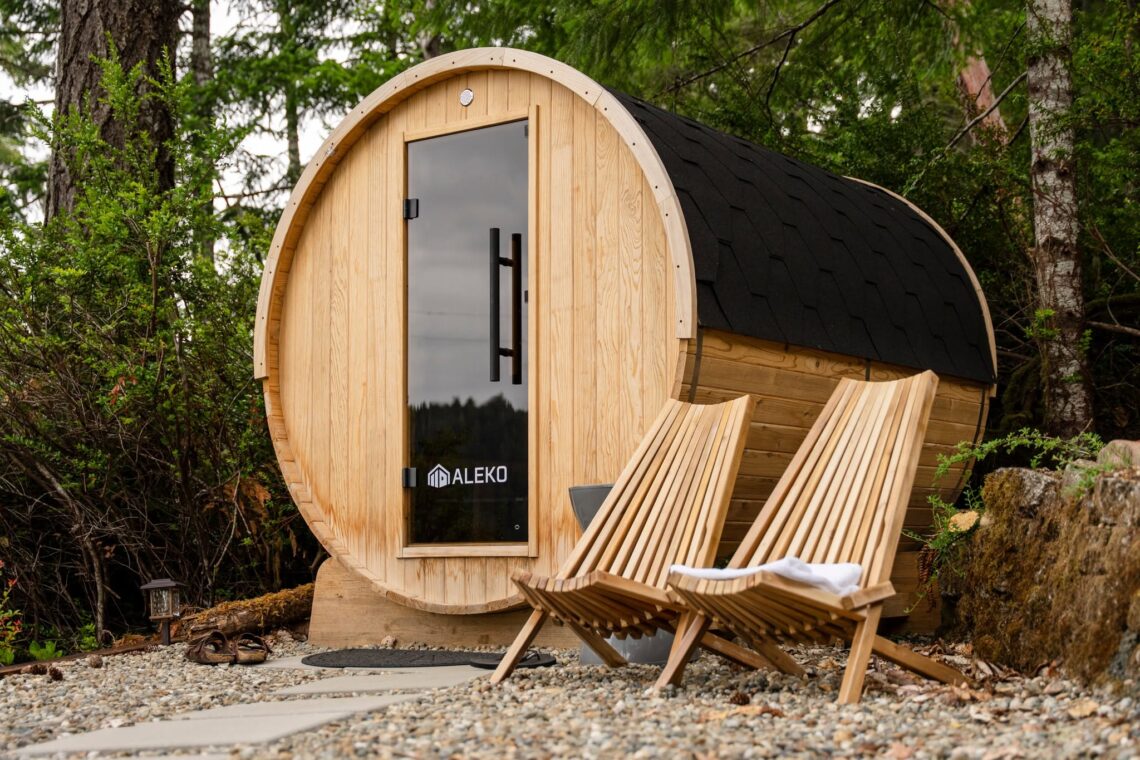
A barrel sauna encloses less air volume than a square cabin with the same seating capacity, so it warms up faster, and a 2-person cabin costs meaningfully less per session than a 6-person one. Buying more capacity than you’ll use is a recurring cost, not just an upfront one.
Usage Habits
Preheating far in advance, letting the timer run after a session ends, and opening the door repeatedly all waste the same energy you just paid to generate. Use a timer or scheduled start instead of preheating early and waiting, and shift sessions off peak hours if your utility bills you on a time-of-use rate plan.
One more habit worth building in: measure instead of guessing. A simple energy monitor on a plug-in 120V unit, or your utility’s hourly usage data for a hardwired unit, will show your real consumption within a week, and consistent short sessions tend to cost less overall than infrequent long ones, since warm-up is the expensive phase either way you use it.
Sauna Electrical Requirements (and Why They Don’t Change Your Bill)
Voltage and amperage determine how your sauna gets wired, not how much energy it consumes. A 240V heater and a 120V heater drawing the same kilowatt-hours cost the same to run; the difference is in installation, not your electricity bill.
Small plug-in units on a standard 120V, 15A circuit are limited to roughly 1.5 to 1.8 kW, which works for compact or infrared models. Most traditional saunas above that size need a dedicated 240V circuit sized to the heater, which requires a licensed electrician. That electrical work is a one-time installation cost, separate from your ongoing running cost, so budget for it on its own. Hand your electrician the heater’s manual and spec sheet before asking for a quote, since the exact circuit requirements vary by model, and whether you can plug a sauna into a regular outlet comes down entirely to that heater’s wattage.
Explore Energy-Efficient ALEKO Saunas
ALEKO’s home saunas lineup spans indoor saunas and outdoor saunas, barrel saunas, and infrared saunas, with sauna heaters sized to match the running costs covered in this guide. A compact option from the 2 person saunas lineup, paired with a smaller heater, lands at the low end of the cost table. A barrel sauna’s curved shape encloses less air than a square cabin of the same capacity, so it warms up faster, and infrared cabins stay at the lowest draw and shortest warm-up of any option here.
Heater choice matters for running cost too. ALEKO’s indoor electric heaters use established brands like Harvia, and outdoor saunas can pair with a wood-burning sauna stove instead, which takes the running cost off your electric bill entirely in exchange for tending a fire each session. Which option fits best depends on your space, household size, heat preference, and budget. None of these is the right choice for everyone, which is exactly why ALEKO offers all of them.
Find a Sauna That Fits Your Space and Your Budget
Running cost is modest and predictable once you size a sauna correctly. A few sessions a week typically land somewhere between $10 and $30 a month, far less than most people assume before they do the math, and the biggest savings come from right-sizing and good habits rather than chasing a specific brand or spending more upfront.
Explore ALEKO’s saunas by size, heat type, and indoor or outdoor placement to find the one that fits both your space and your budget. How much a sauna costs and whether home saunas are worth it cover the rest of what factors into that decision.